
library(dsem)
library(dynlm)
library(ggplot2)
library(reshape)
library(gridExtra)
library(phylopath)
dsem is an R package for fitting dynamic structural
equation models (DSEMs) with a simple user-interface and generic
specification of simultaneous and lagged effects in a non-recursive
structure (Thorson et al. 2024). We here
highlight a few features in particular.
Comparison with linear models
We first show that dsem can be specified such that it
collapses to a standard linear model. To do so, we simulate data with a
single response and single predictor:
# simulate normal distribution
x = rnorm(100)
y = 1 + 0.5 * x + rnorm(100)
data = data.frame(x=x, y=y)

# Fit as linear model
Lm = lm( y ~ x, data=data )

# Fit as DSEM
fit = dsem(
  sem = "x -> y, 0, beta",
  tsdata = ts(data),
  control = dsem_control(quiet=TRUE)
)

# Display output
m1 = rbind(
  "lm" = summary(Lm)$coef[2,1:2],
  "dsem" = summary(fit)[1,9:10]
)
knitr::kable( m1, digits=3)| Estimate | Std_Error | |
|---|---|---|
| lm | 0.616 | 0.108 |
| dsem | 0.616 | 0.107 |
This shows that linear and dynamic structural equation models give identical estimates of the single path coefficient.
We can also calculate leave-one-out residuals and display them using DHARMa:
# sample-based quantile residuals
samples = loo_residuals(fit, what="samples", track_progress=FALSE)
which_use = which(!is.na(data))
fitResp = loo_residuals( fit, what="loo", track_progress=FALSE)[,'est']
simResp = apply(samples, MARGIN=3, FUN=as.vector)[which_use,]

# Build and display DHARMa object
res = DHARMa::createDHARMa(
  simulatedResponse = simResp,
  observedResponse = unlist(data)[which_use],
  fittedPredictedResponse = fitResp )
plot(res)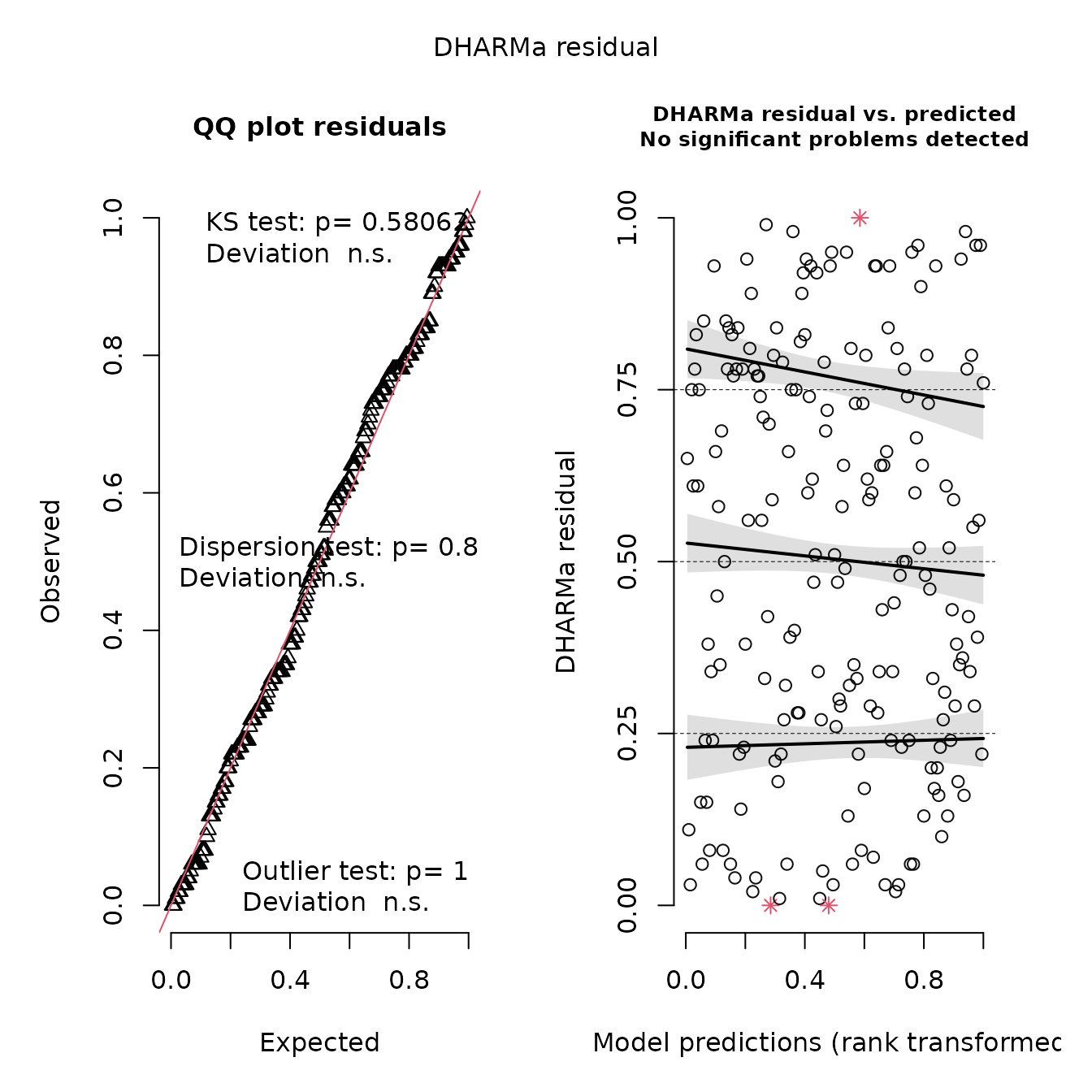
This shows no pattern in the quantile-quantile plot, as expected given that we have a correctly specified model. We can also confirm that this gives identical to results to the linear model:
# Get DSEM Loo residuals and LM working residuals
res = loo_residuals(fit, what="quantiles", track_progress=FALSE)
res0 = resid(Lm,"working")

# Plot comparison
plot( x=res0, y=qnorm(res[,2]),
      xlab="linear model residuals", ylab="dsem residuals" )
abline(a=0,b=1)
Comparison with generalized linear models
Next, we show that DSEM can be specified to collapse to a standard generalized linear model. However, this requires first understanding a bit more about how DSEM treats both measurement and process errors.
In particular, DSEM is capable of fitting a state-space model that incorporates two types of errors:
- Process errors, i.e., exogenous variation in a variable, beyond was is explained by covariates (paths from other variables);
- Measurement errors, i.e., variation in a measurement that follows a specified distribution (e.g., Gaussian, Poisson, etc.), where the variance of measurement errors is then typically estimated;
However, DSEM can then collapse this state-space model to:
- Measurement error model, by turning off process errors. This is done
by fixing the exogenous variation for a given variable at zero (e.g.,
X <-> X, 0, NA, 0fixes the exogenous variation for variable X at zero); - Process-error model, by turning off measurement errors by using
family = fixed()).
A generalized linear mixed model is then equivalent to a state-space model where:
- covariates have no measurement errors;
- the response has no process errors, such that residuals are attributed purely to measurement errors.
We show this equivalence by simulating counts from a log-linked
Poisson GLM, and fitting it using dsem and
glm
# Simulate a log-linked Poisson GLM
x = rnorm(100)
p = 1 + 0.8 * x
y = rpois( length(x), lambda = exp(p) )
data = data.frame(x=x, y=y)

# Fit as generalized linear model
Glm = glm( y ~ x, data=data, family = poisson() )

# Define zero process errors (only process errors) in response y
sem = "
  x -> y, 0, beta
  y <-> y, 0, NA, 0
"

# Fit as DSEM
fit = dsem(
  sem = sem,
  tsdata = ts(data),
  family = list( x = fixed(), y = poisson("log") ),
  control = dsem_control(quiet=TRUE)
)

# Display output
m1 = rbind(
  "glm" = summary(Glm)$coef[2,1:2],
  "dsem" = summary(fit)[1,9:10]
)
knitr::kable( m1, digits=3)| Estimate | Std_Error | |
|---|---|---|
| glm | 0.715 | 0.051 |
| dsem | 0.715 | 0.051 |
We note that this model combines zero-measurement errors for
predictor x with zero-process errors for response
y. This combination requires dsem version
2.0.0 or later, using the new default option
dsem_control( gmrf_parameterization = "gmrf_project"). In
this GLM example, gmrf_parameterization = "gmrf_project"
first calculates a full-rank GMRF for covariate x and then
projects it to response y using a conditional prediction
that has reduced rank. Detecting full-rank vs. reduced-rank then occurs
“behind the scenes”; this option should be fast while allowing many
combinations of turned-off process and measurement errors, but remains
somewhat experimental.
Comparison with dynamic linear models
We next demonstrate dsem using a well-known econometric
model, the Klein-1 model.
data(KleinI, package="AER")
TS = ts(data.frame(KleinI, "time"=time(KleinI) - 1931))

# Specify by declaring each arrow and lag
sem = "
  # Link, lag, param_name
  cprofits -> consumption, 0, a1
  cprofits -> consumption, 1, a2
  pwage -> consumption, 0, a3
  gwage -> consumption, 0, a3

  cprofits -> invest, 0, b1
  cprofits -> invest, 1, b2
  capital -> invest, 0, b3

  gnp -> pwage, 0, c2
  gnp -> pwage, 1, c3
  time -> pwage, 0, c1
"
tsdata = TS[,c("time","gnp","pwage","cprofits",'consumption',
               "gwage","invest","capital")]
fit = dsem(
  sem = sem,
  tsdata = tsdata,
  estimate_delta0 = TRUE,
  control = dsem_control(
    quiet = TRUE,
    newton_loops = 0
  )
)
This model could instead be specified using equation-and-lag notation, which makes the model structure more clear:
# Specify using equations
equations = "
  consumption = a1*cprofits + a2*lag[cprofits,1]+ a3*pwage + a3*gwage
  invest = b1*cprofits + b2*lag[cprofits,1] + b3*capital
  pwage = c1*time + c2*gnp + c3*lag[gnp,1]
"

# Convert and run
sem_equations = convert_equations(equations)
fit = dsem(
  sem = sem_equations,
  tsdata = tsdata,
  estimate_delta0 = TRUE,
  control = dsem_control(
    quiet = TRUE,
    newton_loops = 0
  )
)
We first demonstrate that dsem gives identical results
to dynlm:
# dynlm
fm_cons <- dynlm(consumption ~ cprofits + L(cprofits) + I(pwage + gwage), data = TS)
fm_inv <- dynlm(invest ~ cprofits + L(cprofits) + capital, data = TS)
fm_pwage <- dynlm(pwage ~ gnp + L(gnp) + time, data = TS)

# Compile results
m1 = rbind( summary(fm_cons)$coef[-1,],
            summary(fm_inv)$coef[-1,],
            summary(fm_pwage)$coef[-1,] )[,1:2]
m2 = summary(fit$sdrep)[1:9,]
m = rbind(
  data.frame("var"=rownames(m1),m1,"method"="OLS","eq"=rep(c("C","I","Wp"),each=3)),
  data.frame("var"=rownames(m1),m2,"method"="GMRF","eq"=rep(c("C","I","Wp"),each=3))
)
m = cbind(m, "lower"=m$Estimate-m$Std..Error, "upper"=m$Estimate+m$Std..Error )

# ggplot display of estimates
longform = melt( as.data.frame(KleinI) )
  longform$year = rep( time(KleinI), 9 )
p1 = ggplot( data=longform, aes(x=year, y=value) ) +
  facet_grid( rows=vars(variable), scales="free" ) +
  geom_line( )

p2 = ggplot(data=m, aes(x=interaction(var,eq), y=Estimate, color=method)) +
  geom_point( position=position_dodge(0.9) ) +
  geom_errorbar( aes(ymax=as.numeric(upper),ymin=as.numeric(lower)),
                 width=0.25, position=position_dodge(0.9))  #

p3 = plot( as_fitted_DAG(fit) ) +
     expand_limits(x = c(-0.2,1) )
p4 = plot( as_fitted_DAG(fit, lag=1), text_size=4 ) +
     expand_limits(x = c(-0.2,1), y = c(-0.2,0) )

p1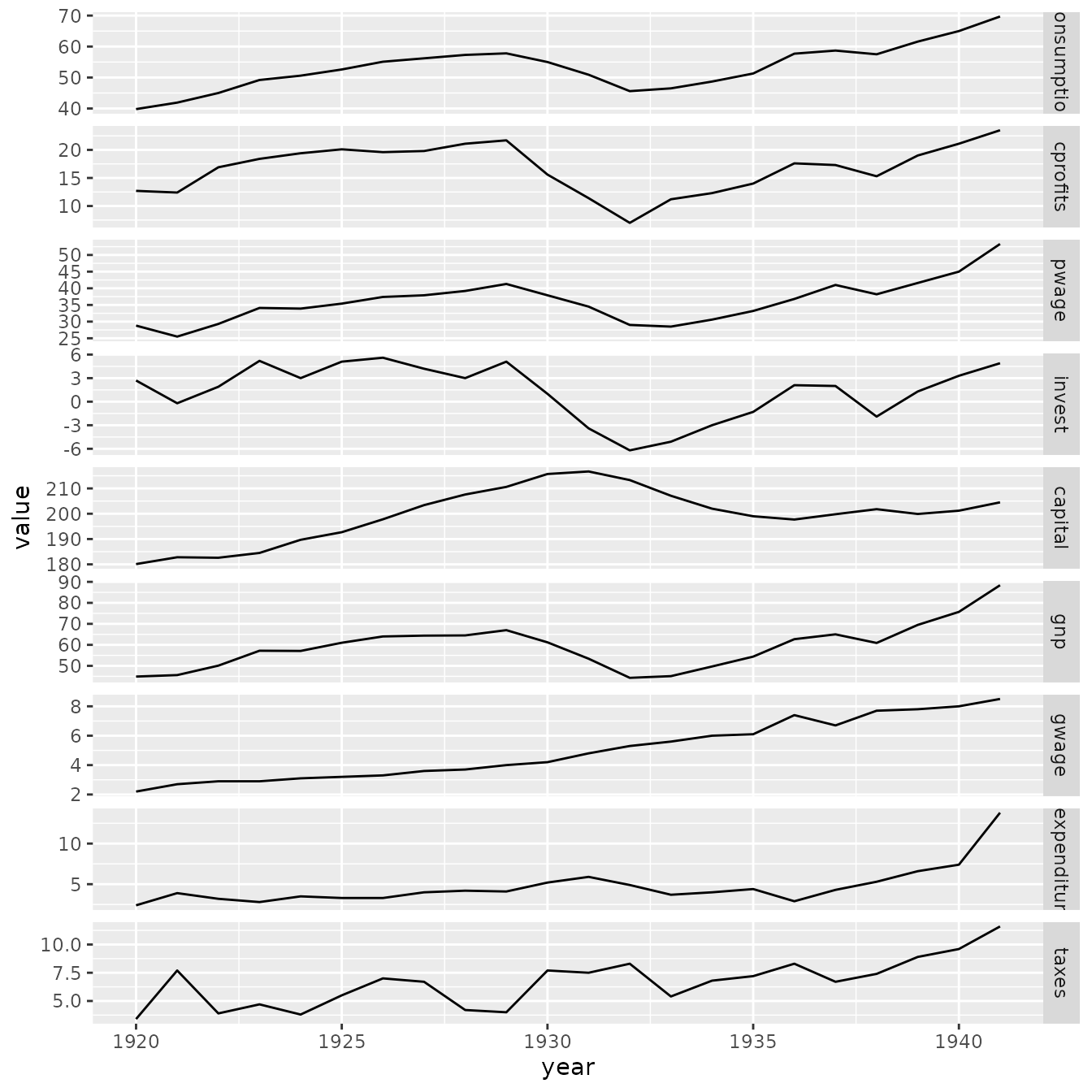
p2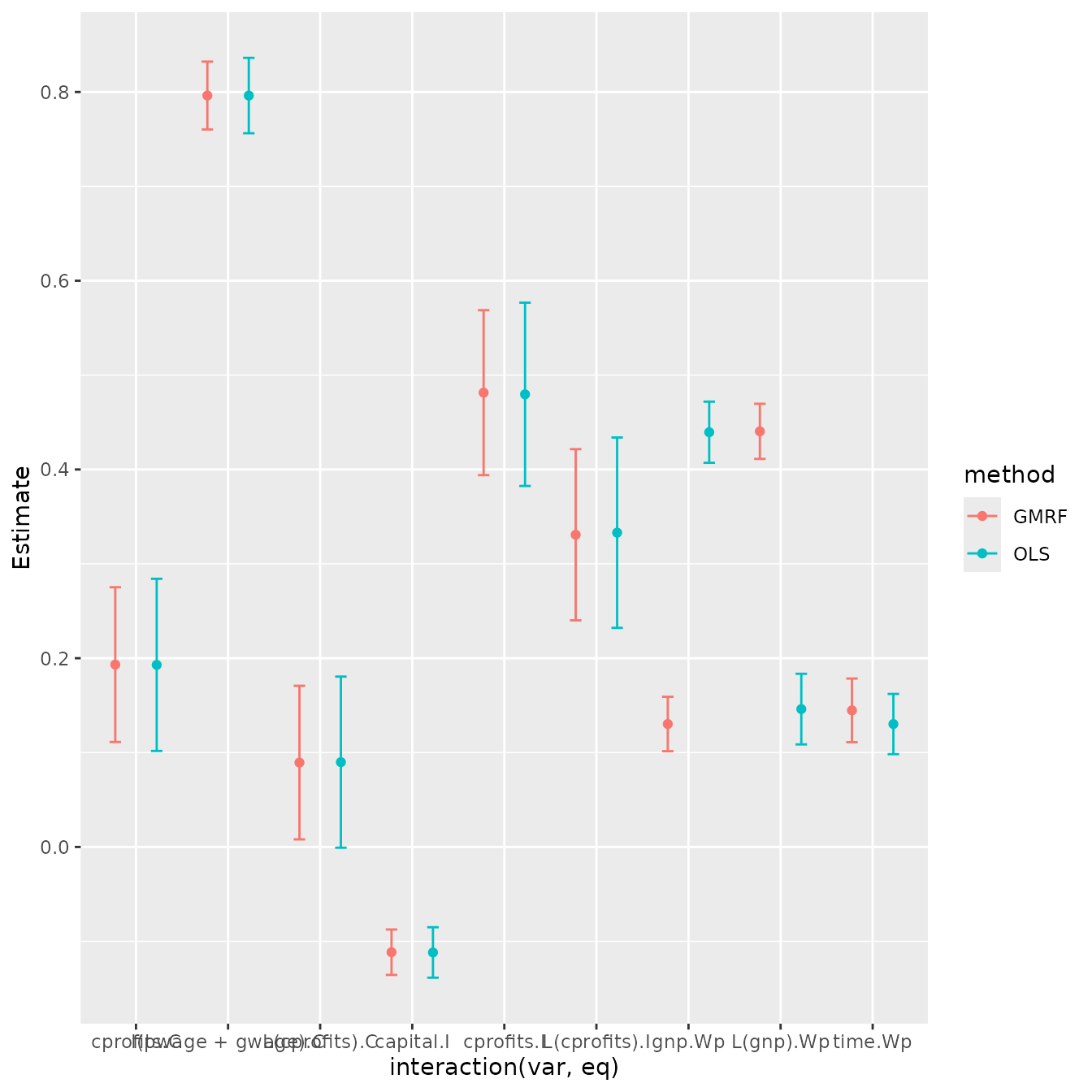
grid.arrange( arrangeGrob(p3, p4, nrow=2) )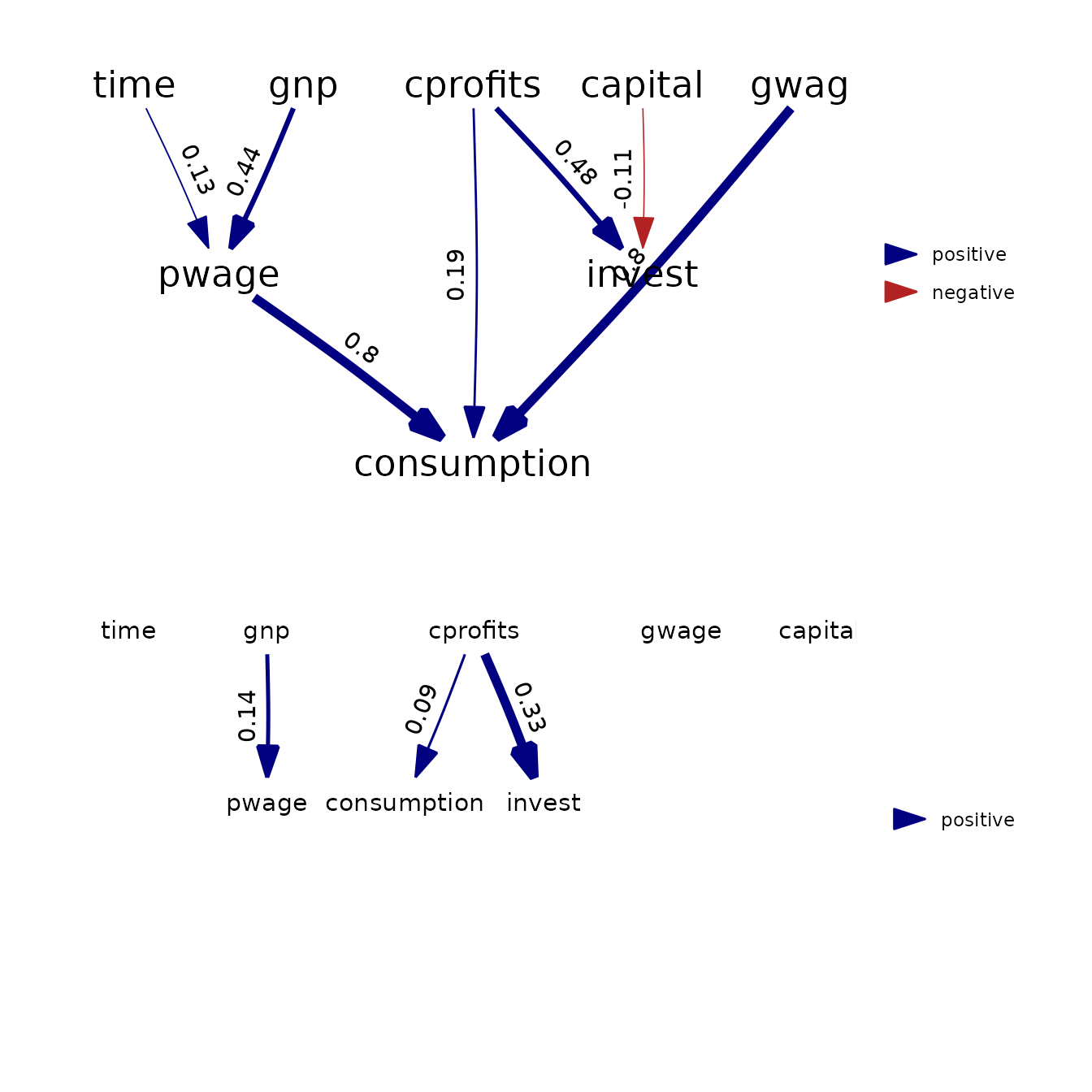
Results show that both packages provide (almost) identical estimates and standard errors.
We can also compare results using the Laplace approximation against those obtained via numerical integration of random effects using MCMC. In this example, MCMC results in somewhat higher estimates of exogenous variance parameters (presumably because those follow a chi-squared distribution with positive skewness), but otherwise the two produce similar estimates.
library(tmbstan)

# MCMC for both fixed and random effects
mcmc = tmbstan( fit$obj, init="last.par.best" )
summary_mcmc = summary(mcmc)
# long-form data frame
m1 = summary_mcmc$summary[1:17,c('mean','sd')]
rownames(m1) = paste0( "b", seq_len(nrow(m1)) )
m2 = summary(fit$sdrep)[1:17,c('Estimate','Std. Error')]
m = rbind(
  data.frame('mean'=m1[,1], 'sd'=m1[,2], 'par'=rownames(m1), "method"="MCMC"),
  data.frame('mean'=m2[,1], 'sd'=m2[,2], 'par'=rownames(m1), "method"="LA")
)
m$lower = m$mean - m$sd
m$upper = m$mean + m$sd

# plot
ggplot(data=m, aes(x=par, y=mean, col=method)) +
  geom_point( position=position_dodge(0.9) ) +
  geom_errorbar( aes(ymax=as.numeric(upper),ymin=as.numeric(lower)),
                 width=0.25, position=position_dodge(0.9))  #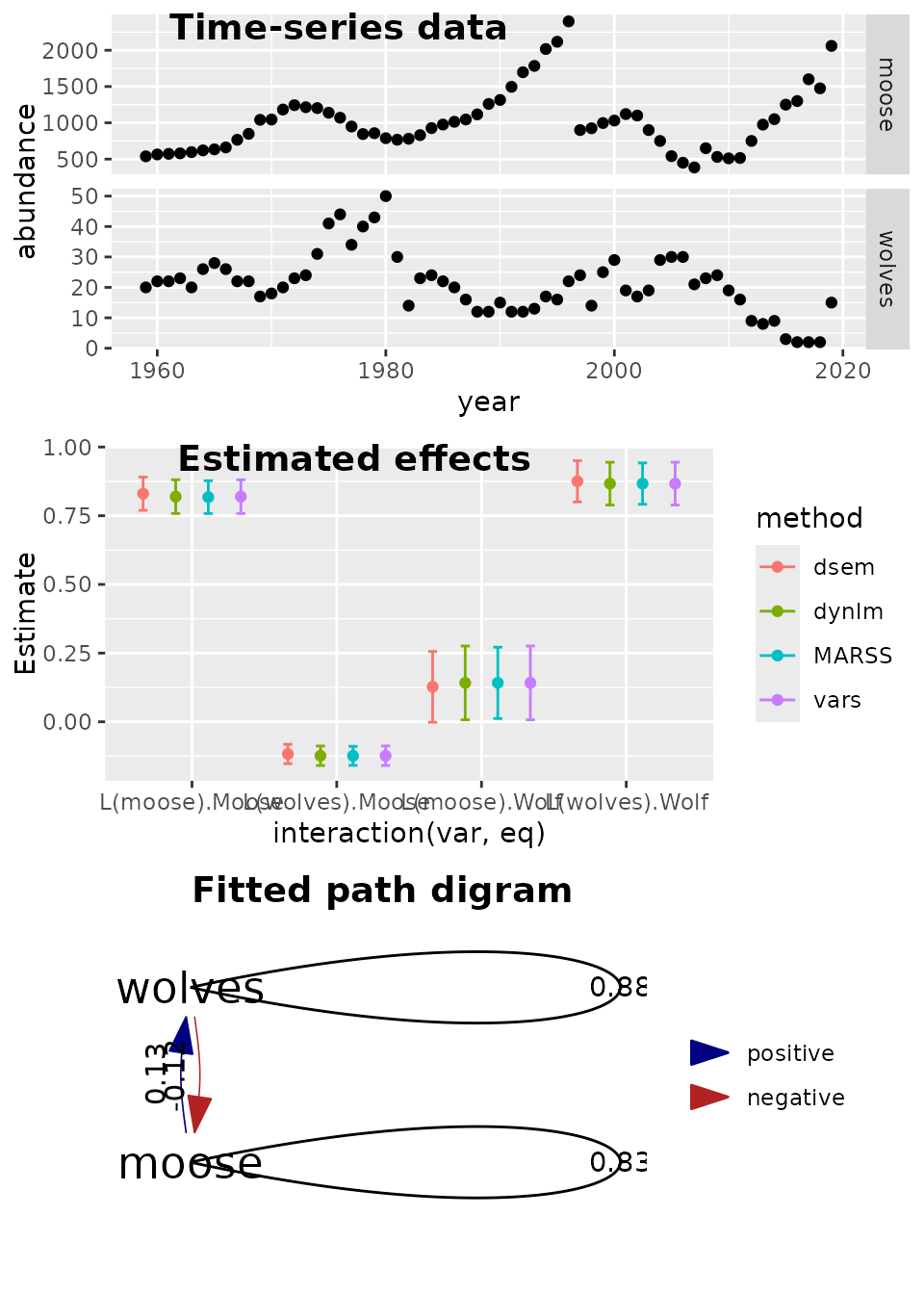
Comparison with vector autoregressive models
We next demonstrate that dsem gives similar results to a
vector autoregressive (VAR) model. To do so, we analyze population
abundance of wolf and moose populations on Isle Royale from 1959 to
2019, downloaded from their website (Vucetich and
Peterson 2012) (URL: www.isleroyalewolf.org).
This dataset was previously analyzed by in Chapter 14 of the User Manual for the R-package MARSS (Holmes et al. 2012).
Here, we compare fits using dsem with
dynlm, as well as a vector autoregressive model package
vars, and finally with MARSS.
data(isle_royale)
data = ts( log(isle_royale[,2:3]), start=1959)

sem = "
  # Link, lag, param_name
  wolves -> wolves, 1, arW
  moose -> wolves, 1, MtoW
  wolves -> moose, 1, WtoM
  moose -> moose, 1, arM
"
# initial first without delta0 (to improve starting values)
fit0 = dsem(
  sem = sem,
  tsdata = data,
  estimate_delta0 = FALSE,
  control = dsem_control(
    quiet = FALSE,
    getsd = FALSE
  )
)
#>   Coefficient_name Number_of_coefficients   Type
#> 1           beta_z                      6  Fixed
#> 2             mu_j                      2 Random

#
parameters = fit0$obj$env$parList()
  parameters$delta0_j = rep( 0, ncol(data) )

# Refit with delta0
fit = dsem(
  sem = sem,
  tsdata = data,
  estimate_delta0 = TRUE,
  control = dsem_control(
    quiet=TRUE,
    parameters = parameters
  )
)

# dynlm
fm_wolf = dynlm( wolves ~ 1 + L(wolves) + L(moose), data=data )   #
fm_moose = dynlm( moose ~ 1 + L(wolves) + L(moose), data=data )   #

# MARSS
library(MARSS)
z.royale.dat <- t(scale(data.frame(data),center=TRUE,scale=FALSE))
royale.model.1 <- list(
  Z = "identity",
  B = "unconstrained",
  Q = "diagonal and unequal",
  R = "zero",
  U = "zero"
)
kem.1 <- MARSS(z.royale.dat, model = royale.model.1)
#> Success! abstol and log-log tests passed at 19 iterations.
#> Alert: conv.test.slope.tol is 0.5.
#> Test with smaller values (<0.1) to ensure convergence.
#>
#> MARSS fit is
#> Estimation method: kem
#> Convergence test: conv.test.slope.tol = 0.5, abstol = 0.001
#> Estimation converged in 19 iterations.
#> Log-likelihood: -3.21765
#> AIC: 22.4353   AICc: 23.70964
#>
#>                       Estimate
#> B.(1,1)                 0.8669
#> B.(2,1)                -0.1240
#> B.(1,2)                 0.1417
#> B.(2,2)                 0.8176
#> Q.(X.wolves,X.wolves)   0.1341
#> Q.(X.moose,X.moose)     0.0284
#> x0.X.wolves             0.2324
#> x0.X.moose             -0.6476
#> Initial states (x0) defined at t=0
#>
#> Standard errors have not been calculated.
#> Use MARSSparamCIs to compute CIs and bias estimates.
SE <- MARSSparamCIs( kem.1 )

# Using VAR package
library(vars)
var = VAR( data, type="const" )

### Compile
m1 = rbind( summary(fm_wolf)$coef[-1,], summary(fm_moose)$coef[-1,] )[,1:2]
m2 = summary(fit$sdrep)[1:4,]
#m2 = cbind( "Estimate"=fit$opt$par, "Std. Error"=fit$sdrep$par.fixed )[1:4,]
m3 = cbind( SE$parMean[c(1,3,2,4)], SE$par.se$B[c(1,3,2,4)] )
colnames(m3) = colnames(m2)
m4 = rbind( summary(var$varresult$wolves)$coef[-3,], summary(var$varresult$moose)$coef[-3,] )[,1:2]

# Bundle
m = rbind(
  data.frame("var"=rownames(m1), m1, "method"="dynlm", "eq"=rep(c("Wolf","Moose"),each=2)),
  data.frame("var"=rownames(m1), m2, "method"="dsem", "eq"=rep(c("Wolf","Moose"),each=2)),
  data.frame("var"=rownames(m1), m3, "method"="MARSS", "eq"=rep(c("Wolf","Moose"),each=2)),
  data.frame("var"=rownames(m1), m4, "method"="vars", "eq"=rep(c("Wolf","Moose"),each=2))
)
#knitr::kable( m1, digits=3)
#knitr::kable( m2, digits=3)

m = cbind(m, "lower"=m$Estimate-m$Std..Error, "upper"=m$Estimate+m$Std..Error )

# ggplot estimates ... interaction(x,y) causes an error sometimes
library(ggplot2)
library(ggpubr)
library(ggraph)
longform = reshape( isle_royale, idvar = "year", direction="long", varying=list(2:3), v.names="abundance", timevar="species", times=c("wolves","moose") )
p1 = ggplot( data=longform, aes(x=year, y=abundance) ) +
  facet_grid( rows=vars(species), scales="free" ) +
  geom_point( )

p2 = ggplot(data=m, aes(x=interaction(var,eq), y=Estimate, color=method)) +
  geom_point( position=position_dodge(0.9) ) +
  geom_errorbar( aes(ymax=as.numeric(upper),ymin=as.numeric(lower)),
                 width=0.25, position=position_dodge(0.9))  #
p3 = plot( as_fitted_DAG(fit, lag=1), rotation=0 ) +
     geom_edge_loop( aes( label=round(weight,2), direction=0)) + #arrow=arrow(), , angle_calc="along", label_dodge=grid::unit(10,"points") )
     expand_limits(x = c(-0.1,0) )

ggarrange( p1, p2, p3,
           labels = c("Time-series data", "Estimated effects", "Fitted path digram"),
           ncol = 1, nrow = 3)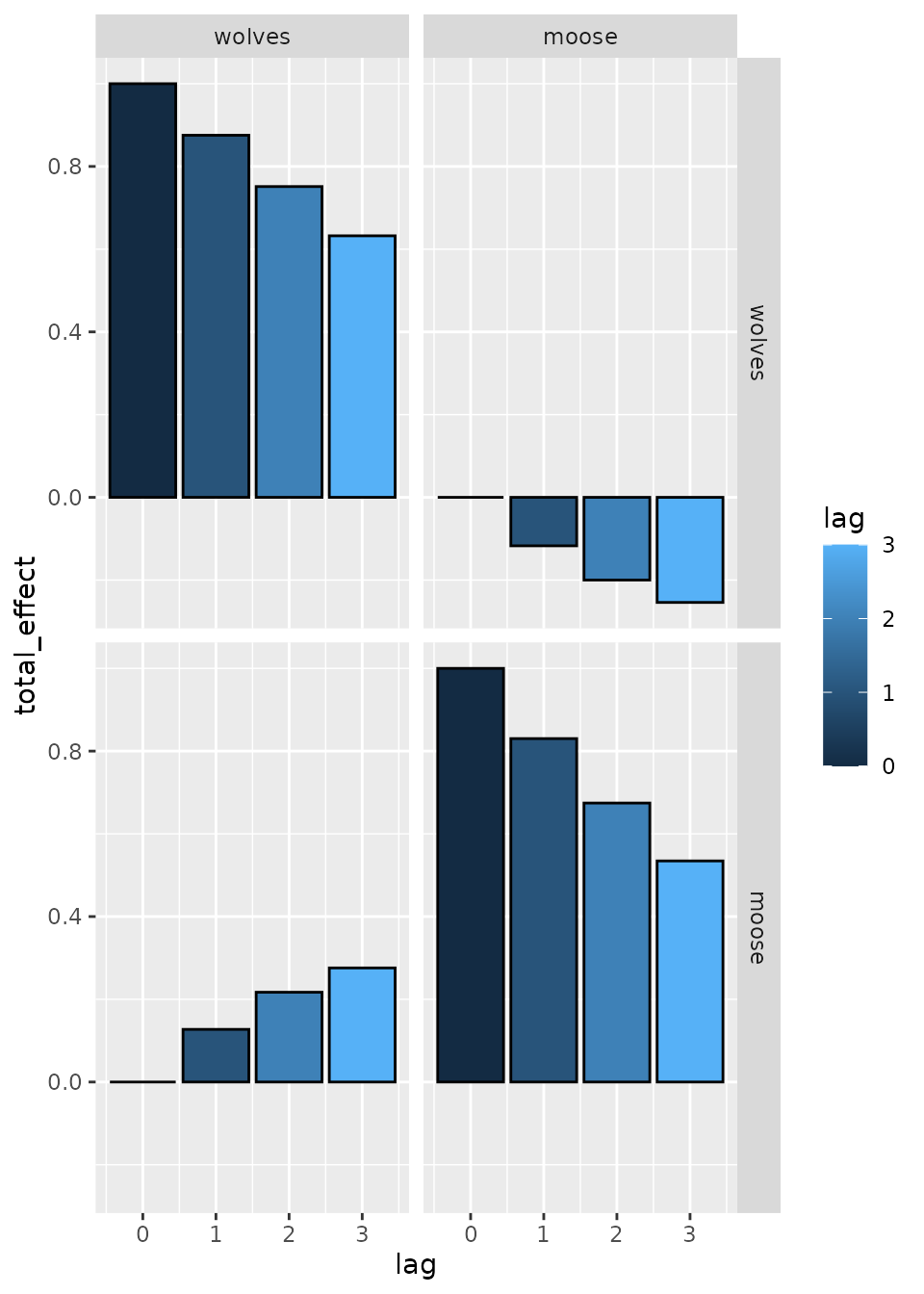
We can then plot the total effects, which shows that effects propagate through time due to both interactions and density dependence:
# Calculate total effects
effect = total_effect( fit )

# Plot total effect
ggplot( effect) +
  geom_bar( aes(lag, total_effect, fill=lag), stat='identity', col='black', position='dodge' ) +
  facet_grid( from ~ to  )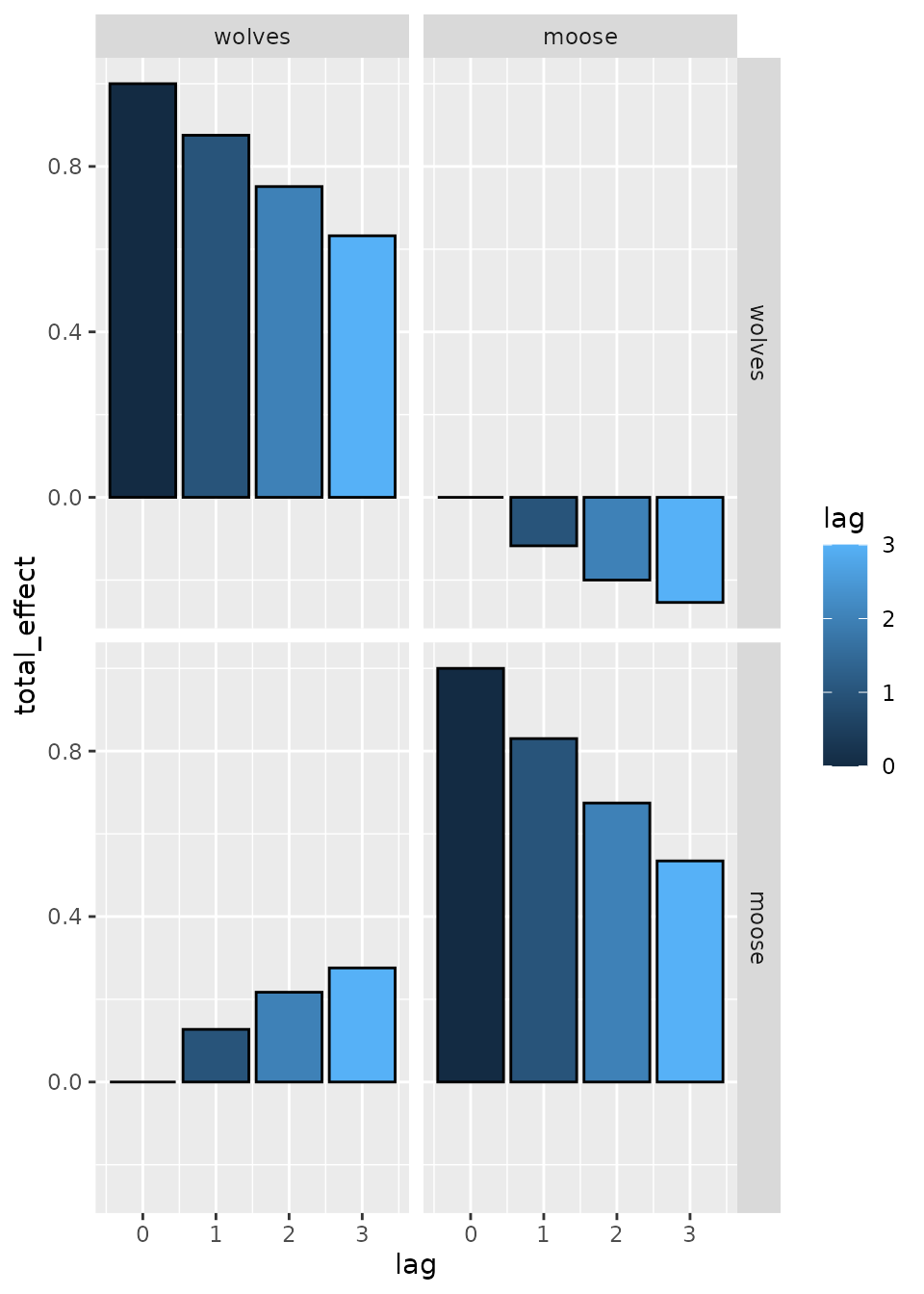
Results again show that dsem can estimate parameters for
a vector autoregressive model (VAM), and it exactly matches results from
vars, using dynlm, or using
MARSS.
Multi-causal ecosystem synthesis
We next replicate an analysis involving climate, forage fishes, stomach contents, and recruitment of a predatory fish.
data(bering_sea)
Z = ts( bering_sea )
family = Map(function(.) fixed(), colnames(Z))

# Specify model
sem = "
  # Link, lag, param_name
  log_seaice -> log_CP, 0, seaice_to_CP
  log_CP -> log_Cfall, 0, CP_to_Cfall
  log_CP -> log_Esummer, 0, CP_to_E
  log_PercentEuph -> log_RperS, 0, Seuph_to_RperS
  log_PercentCop -> log_RperS, 0, Scop_to_RperS
  log_Esummer -> log_PercentEuph, 0, Esummer_to_Suph
  log_Cfall -> log_PercentCop, 0, Cfall_to_Scop
  SSB -> log_RperS, 0, SSB_to_RperS

  log_seaice -> log_seaice, 1, AR1, 0.001
  log_CP -> log_CP, 1,  AR2, 0.001
  log_Cfall -> log_Cfall, 1, AR4, 0.001
  log_Esummer -> log_Esummer, 1, AR5, 0.001
  SSB -> SSB, 1, AR6, 0.001
  log_RperS ->  log_RperS, 1, AR7, 0.001
  log_PercentEuph -> log_PercentEuph, 1, AR8, 0.001
  log_PercentCop -> log_PercentCop, 1, AR9, 0.001
"

# Fit
fit = dsem(
  sem = sem,
  tsdata = Z,
  family = family,
  control = dsem_control(
    use_REML=FALSE,
    quiet=TRUE
  )
)
ParHat = fit$obj$env$parList()
# summary( fit )
# Timeseries plot
oldpar <- par(no.readonly = TRUE)
par( mfcol=c(3,3), mar=c(2,2,2,0), mgp=c(2,0.5,0), tck=-0.02 )
for(i in 1:ncol(bering_sea)){
  tmp = bering_sea[,i,drop=FALSE]
  tmp = cbind( tmp, "pred"=ParHat$x_tj[,i] )
  SD = as.list(fit$sdrep,what="Std.")$x_tj[,i]
  tmp = cbind( tmp, "lower"=tmp[,2] - ifelse(is.na(SD),0,SD),
                    "upper"=tmp[,2] + ifelse(is.na(SD),0,SD) )
  #
  plot( x=rownames(bering_sea), y=tmp[,1], ylim=range(tmp,na.rm=TRUE),
        type="p", main=colnames(bering_sea)[i], pch=20, cex=2 )
  lines( x=rownames(bering_sea), y=tmp[,2], type="l", lwd=2,
         col="blue", lty="solid" )
  polygon( x=c(rownames(bering_sea),rev(rownames(bering_sea))),
           y=c(tmp[,3],rev(tmp[,4])), col=rgb(0,0,1,0.2), border=NA )
}
par(oldpar)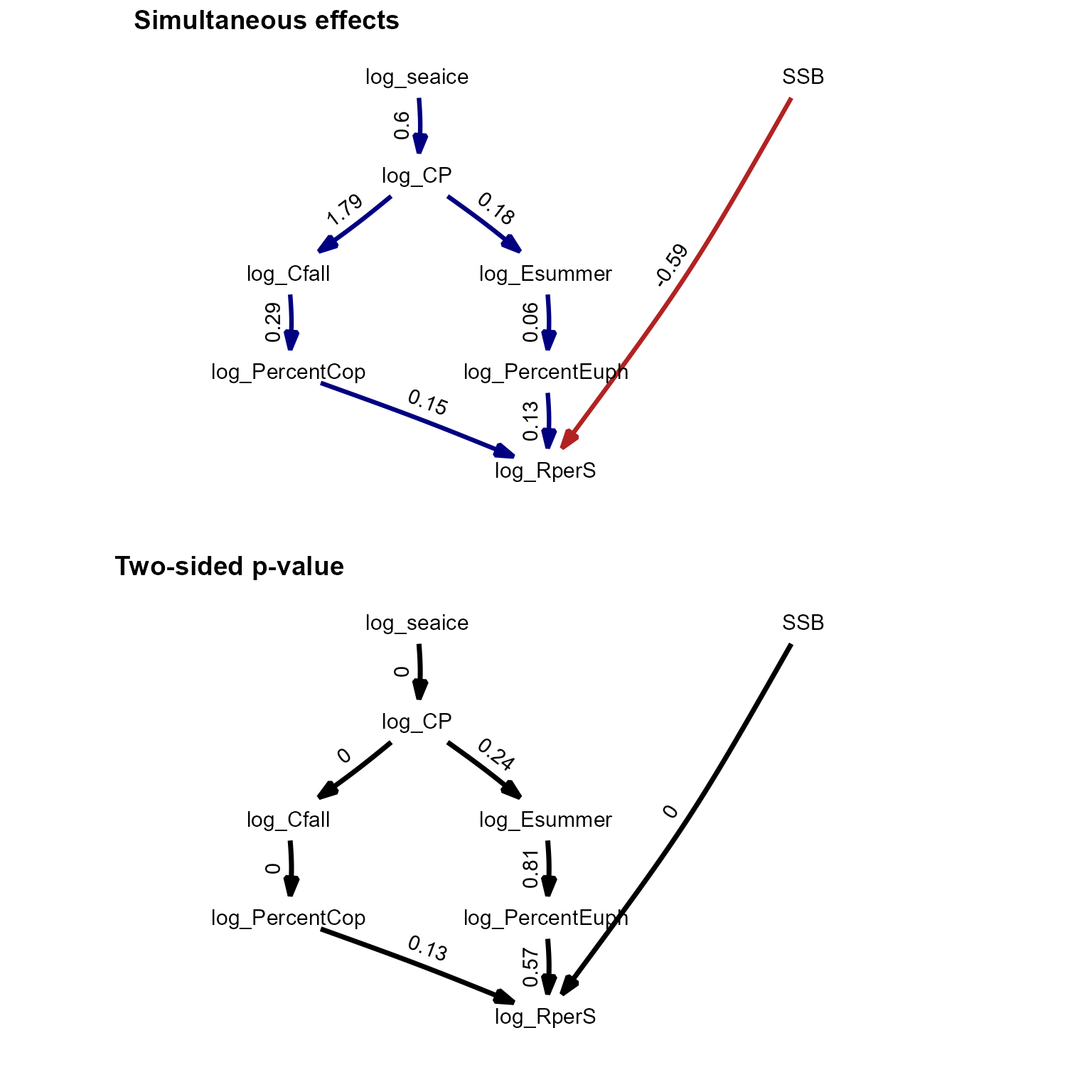
#
library(phylopath)
library(ggplot2)
library(ggpubr)
library(reshape)
library(gridExtra)
longform = melt( bering_sea )
  longform$year = rep( 1963:2023, ncol(bering_sea) )
p0 = ggplot( data=longform, aes(x=year, y=value) ) +
  facet_grid( rows=vars(variable), scales="free" ) +
  geom_point( )

p1 = plot( (as_fitted_DAG(fit)), edge.width=1, type="width",
           text_size=4, show.legend=FALSE,
           arrow = grid::arrow(type='closed', 18, grid::unit(10,'points')) ) +
     scale_x_continuous(expand = c(0.4, 0.1))
p1$layers[[1]]$mapping$edge_width = 1
p2 = plot( (as_fitted_DAG(fit, what="p_value")), edge.width=1, type="width",
           text_size=4, show.legend=FALSE, colors=c('black', 'black'),
           arrow = grid::arrow(type='closed', 18, grid::unit(10,'points')) ) +
     scale_x_continuous(expand = c(0.4, 0.1))
p2$layers[[1]]$mapping$edge_width = 0.5

#grid.arrange( arrangeGrob( p0+ggtitle("timeseries"),
#              arrangeGrob( p1+ggtitle("Estimated path diagram"),
#                           p2+ggtitle("Estimated p-values"), nrow=2), ncol=2 ) )
ggarrange(p1, p2, labels = c("Simultaneous effects", "Two-sided p-value"),
                    ncol = 1, nrow = 2)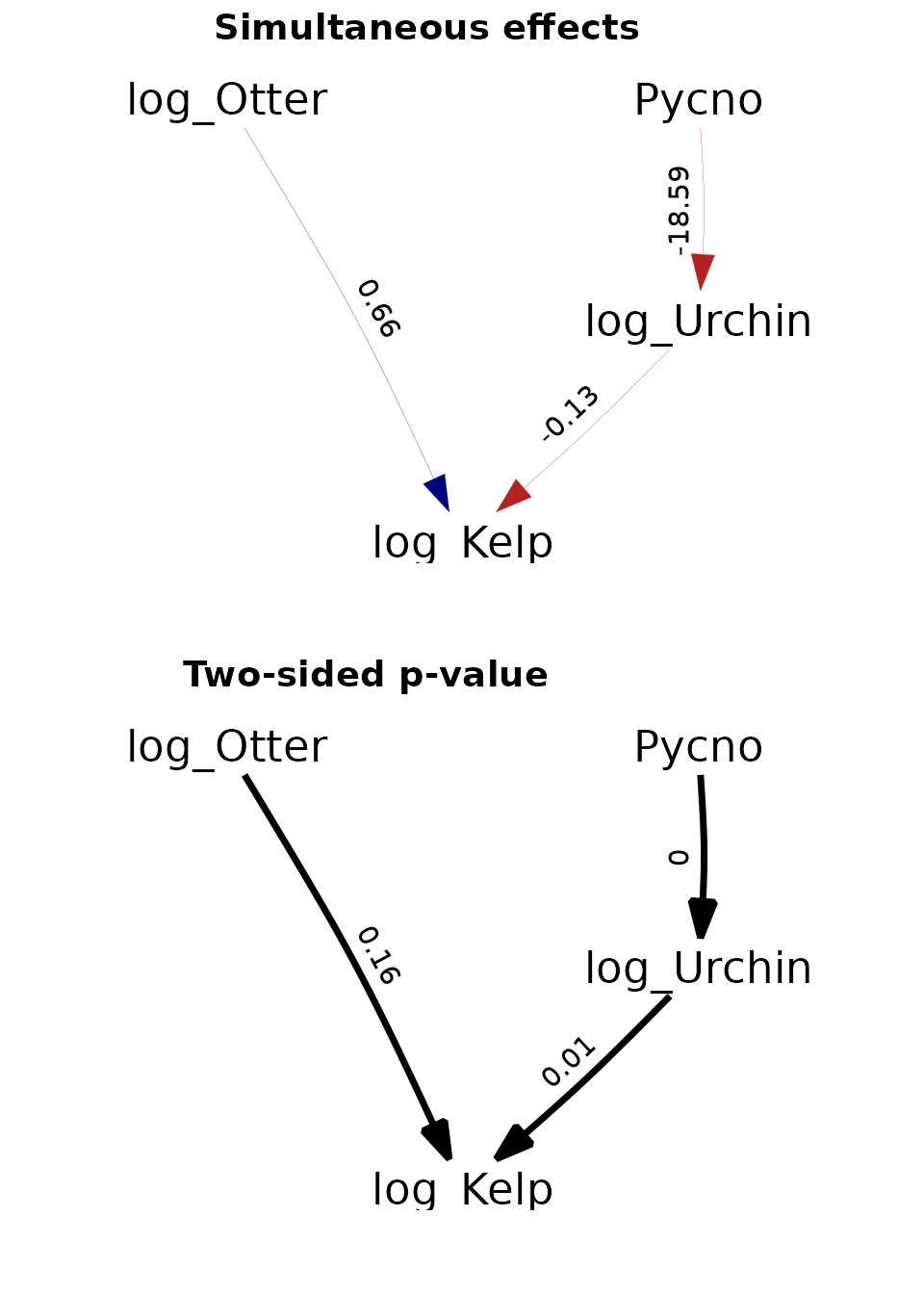
These results are further discussed in the paper describing dsem.
Site-replicated trophic cascade
Finally, we replicate an analysis involving a trophic cascade involving sea stars predators, sea urchin consumers, and kelp producers.
data(sea_otter)
Z = ts( sea_otter[,-1] )

# Specify model
sem = "
  Pycno_CANNERY_DC -> log_Urchins_CANNERY_DC, 0, x2
  log_Urchins_CANNERY_DC -> log_Kelp_CANNERY_DC, 0, x3
  log_Otter_Count_CANNERY_DC -> log_Kelp_CANNERY_DC, 0, x4

  Pycno_CANNERY_UC -> log_Urchins_CANNERY_UC, 0, x2
  log_Urchins_CANNERY_UC -> log_Kelp_CANNERY_UC, 0, x3
  log_Otter_Count_CANNERY_UC -> log_Kelp_CANNERY_UC, 0, x4

  Pycno_HOPKINS_DC -> log_Urchins_HOPKINS_DC, 0, x2
  log_Urchins_HOPKINS_DC -> log_Kelp_HOPKINS_DC, 0, x3
  log_Otter_Count_HOPKINS_DC -> log_Kelp_HOPKINS_DC, 0, x4

  Pycno_HOPKINS_UC -> log_Urchins_HOPKINS_UC, 0, x2
  log_Urchins_HOPKINS_UC -> log_Kelp_HOPKINS_UC, 0, x3
  log_Otter_Count_HOPKINS_UC -> log_Kelp_HOPKINS_UC, 0, x4

  Pycno_LOVERS_DC -> log_Urchins_LOVERS_DC, 0, x2
  log_Urchins_LOVERS_DC -> log_Kelp_LOVERS_DC, 0, x3
  log_Otter_Count_LOVERS_DC -> log_Kelp_LOVERS_DC, 0, x4

  Pycno_LOVERS_UC -> log_Urchins_LOVERS_UC, 0, x2
  log_Urchins_LOVERS_UC -> log_Kelp_LOVERS_UC, 0, x3
  log_Otter_Count_LOVERS_UC -> log_Kelp_LOVERS_UC, 0, x4

  Pycno_MACABEE_DC -> log_Urchins_MACABEE_DC, 0, x2
  log_Urchins_MACABEE_DC -> log_Kelp_MACABEE_DC, 0, x3
  log_Otter_Count_MACABEE_DC -> log_Kelp_MACABEE_DC, 0, x4

  Pycno_MACABEE_UC -> log_Urchins_MACABEE_UC, 0, x2
  log_Urchins_MACABEE_UC -> log_Kelp_MACABEE_UC, 0, x3
  log_Otter_Count_MACABEE_UC -> log_Kelp_MACABEE_UC, 0, x4

  Pycno_OTTER_PT_DC -> log_Urchins_OTTER_PT_DC, 0, x2
  log_Urchins_OTTER_PT_DC -> log_Kelp_OTTER_PT_DC, 0, x3
  log_Otter_Count_OTTER_PT_DC -> log_Kelp_OTTER_PT_DC, 0, x4

  Pycno_OTTER_PT_UC -> log_Urchins_OTTER_PT_UC, 0, x2
  log_Urchins_OTTER_PT_UC -> log_Kelp_OTTER_PT_UC, 0, x3
  log_Otter_Count_OTTER_PT_UC -> log_Kelp_OTTER_PT_UC, 0, x4

  Pycno_PINOS_CEN -> log_Urchins_PINOS_CEN, 0, x2
  log_Urchins_PINOS_CEN -> log_Kelp_PINOS_CEN, 0, x3
  log_Otter_Count_PINOS_CEN -> log_Kelp_PINOS_CEN, 0, x4

  Pycno_SIREN_CEN -> log_Urchins_SIREN_CEN, 0, x2
  log_Urchins_SIREN_CEN -> log_Kelp_SIREN_CEN, 0, x3
  log_Otter_Count_SIREN_CEN -> log_Kelp_SIREN_CEN, 0, x4

  # AR1
  Pycno_CANNERY_DC -> Pycno_CANNERY_DC, 1, ar1
  log_Urchins_CANNERY_DC -> log_Urchins_CANNERY_DC, 1, ar2
  log_Otter_Count_CANNERY_DC -> log_Otter_Count_CANNERY_DC, 1, ar3
  log_Kelp_CANNERY_DC -> log_Kelp_CANNERY_DC, 1, ar4

  Pycno_CANNERY_UC -> Pycno_CANNERY_UC, 1, ar1
  log_Urchins_CANNERY_UC -> log_Urchins_CANNERY_UC, 1, ar2
  log_Otter_Count_CANNERY_UC -> log_Otter_Count_CANNERY_UC, 1, ar3
  log_Kelp_CANNERY_UC -> log_Kelp_CANNERY_UC, 1, ar4

  Pycno_HOPKINS_DC -> Pycno_HOPKINS_DC, 1, ar1
  log_Urchins_HOPKINS_DC -> log_Urchins_HOPKINS_DC, 1, ar2
  log_Otter_Count_HOPKINS_DC -> log_Otter_Count_HOPKINS_DC, 1, ar3
  log_Kelp_HOPKINS_DC -> log_Kelp_HOPKINS_DC, 1, ar4

  Pycno_HOPKINS_UC -> Pycno_HOPKINS_UC, 1, ar1
  log_Urchins_HOPKINS_UC -> log_Urchins_HOPKINS_UC, 1, ar2
  log_Otter_Count_HOPKINS_UC -> log_Otter_Count_HOPKINS_UC, 1, ar3
  log_Kelp_HOPKINS_UC -> log_Kelp_HOPKINS_UC, 1, ar4

  Pycno_LOVERS_DC -> Pycno_LOVERS_DC, 1, ar1
  log_Urchins_LOVERS_DC -> log_Urchins_LOVERS_DC, 1, ar2
  log_Otter_Count_LOVERS_DC -> log_Otter_Count_LOVERS_DC, 1, ar3
  log_Kelp_LOVERS_DC -> log_Kelp_LOVERS_DC, 1, ar4

  Pycno_LOVERS_UC -> Pycno_LOVERS_UC, 1, ar1
  log_Urchins_LOVERS_UC -> log_Urchins_LOVERS_UC, 1, ar2
  log_Otter_Count_LOVERS_UC -> log_Otter_Count_LOVERS_UC, 1, ar3
  log_Kelp_LOVERS_UC -> log_Kelp_LOVERS_UC, 1, ar4

  Pycno_MACABEE_DC -> Pycno_MACABEE_DC, 1, ar1
  log_Urchins_MACABEE_DC -> log_Urchins_MACABEE_DC, 1, ar2
  log_Otter_Count_MACABEE_DC -> log_Otter_Count_MACABEE_DC, 1, ar3
  log_Kelp_MACABEE_DC -> log_Kelp_MACABEE_DC, 1, ar4

  Pycno_MACABEE_UC -> Pycno_MACABEE_UC, 1, ar1
  log_Urchins_MACABEE_UC -> log_Urchins_MACABEE_UC, 1, ar2
  log_Otter_Count_MACABEE_UC -> log_Otter_Count_MACABEE_UC, 1, ar3
  log_Kelp_MACABEE_UC -> log_Kelp_MACABEE_UC, 1, ar4

  Pycno_OTTER_PT_DC -> Pycno_OTTER_PT_DC, 1, ar1
  log_Urchins_OTTER_PT_DC -> log_Urchins_OTTER_PT_DC, 1, ar2
  log_Otter_Count_OTTER_PT_DC -> log_Otter_Count_OTTER_PT_DC, 1, ar3
  log_Kelp_OTTER_PT_DC -> log_Kelp_OTTER_PT_DC, 1, ar4

  Pycno_OTTER_PT_UC -> Pycno_OTTER_PT_UC, 1, ar1
  log_Urchins_OTTER_PT_UC -> log_Urchins_OTTER_PT_UC, 1, ar2
  log_Otter_Count_OTTER_PT_UC -> log_Otter_Count_OTTER_PT_UC, 1, ar3
  log_Kelp_OTTER_PT_UC -> log_Kelp_OTTER_PT_UC, 1, ar4

  Pycno_PINOS_CEN -> Pycno_PINOS_CEN, 1, ar1
  log_Urchins_PINOS_CEN -> log_Urchins_PINOS_CEN, 1, ar2
  log_Otter_Count_PINOS_CEN -> log_Otter_Count_PINOS_CEN, 1, ar3
  log_Kelp_PINOS_CEN -> log_Kelp_PINOS_CEN, 1, ar4

  Pycno_SIREN_CEN -> Pycno_SIREN_CEN, 1, ar1
  log_Urchins_SIREN_CEN -> log_Urchins_SIREN_CEN, 1, ar2
  log_Otter_Count_SIREN_CEN -> log_Otter_Count_SIREN_CEN, 1, ar3
  log_Kelp_SIREN_CEN -> log_Kelp_SIREN_CEN, 1, ar4
"

# Fit model
fit = dsem(
  sem = sem,
  tsdata = Z,
  control = dsem_control(
    use_REML=FALSE,
    quiet=TRUE
  )
)

#
library(phylopath)
library(ggplot2)
library(ggpubr)
get_part = function(x){
  vars = c("log_Kelp","log_Otter","log_Urchin","Pycno")
  index = sapply( vars, FUN=\(y) grep(y,rownames(x$coef))[1] )
  x$coef = x$coef[index,index]
  dimnames(x$coef) = list( vars, vars )
  return(x)
}
p1 = plot( get_part(as_fitted_DAG(fit)), type="width", show.legend=FALSE)
p1$layers[[1]]$mapping$edge_width = 0.5
p2 = plot( get_part(as_fitted_DAG(fit, what="p_value" )), type="width",
           show.legend=FALSE, colors=c('black', 'black'))
p2$layers[[1]]$mapping$edge_width = 0.1

longform = melt( sea_otter[,-1], as.is=TRUE )
longform$X1 = 1999:2019[longform$X1]
longform$Site = gsub( "log_Kelp_", "",
                gsub( "log_Urchins_", "",
                gsub( "Pycno_", "",
                gsub( "log_Otter_Count_", "", longform$X2))))
longform$Species = sapply( seq_len(nrow(longform)), FUN=\(i)gsub(longform$Site[i],"",longform$X2[i]) )
p3 = ggplot( data=longform, aes(x=X1, y=value, col=Species) ) +
  facet_grid( rows=vars(Site), scales="free" ) +
  geom_line( )

ggarrange(p1 + scale_x_continuous(expand = c(0.3, 0)),
                    p2 + scale_x_continuous(expand = c(0.3, 0)),
                    labels = c("Simultaneous effects", "Two-sided p-value"),
                    ncol = 1, nrow = 2)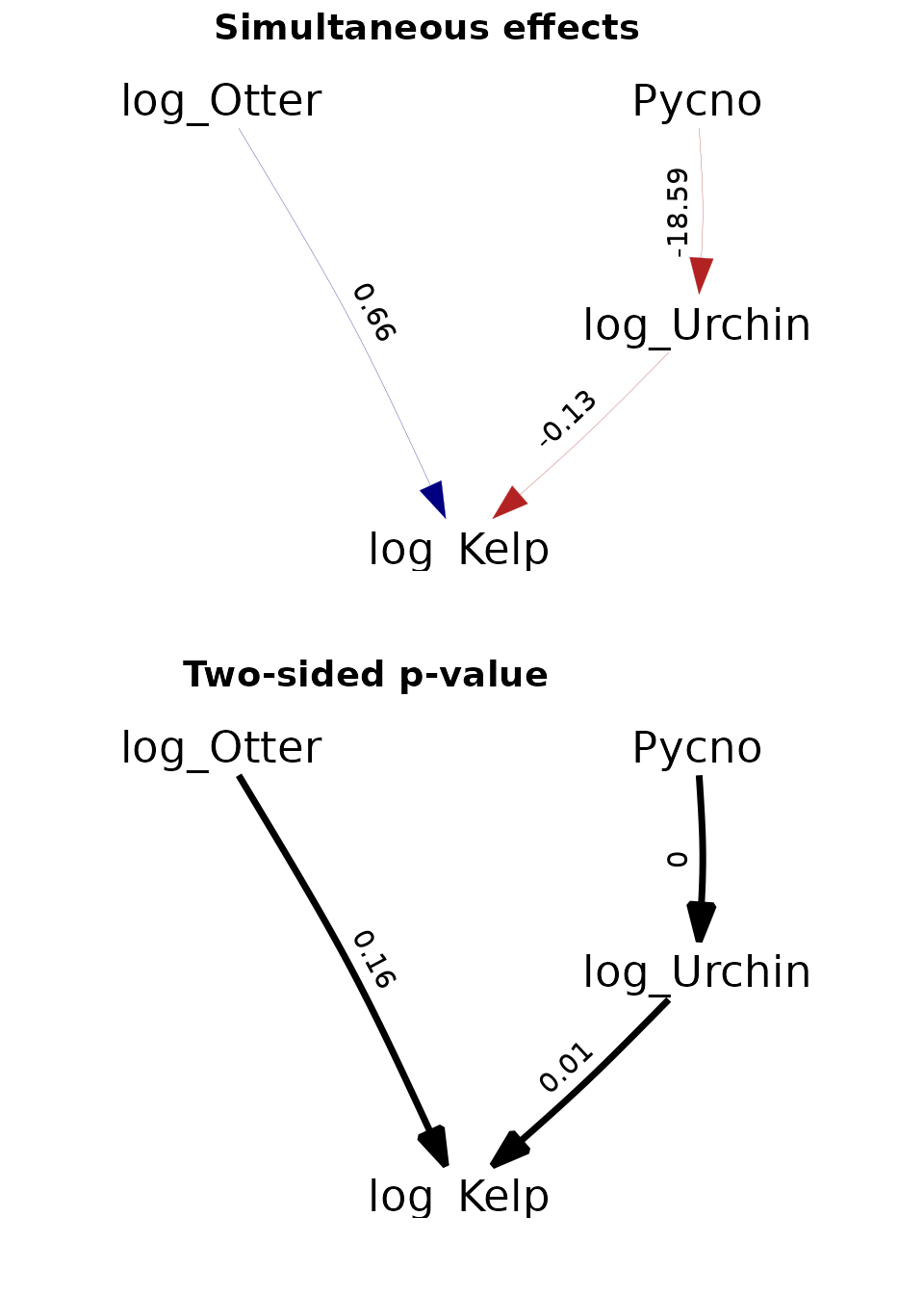
Again, these results are further discussed in the paper describing dsem.
Runtime for this vignette: 25.13 secs